Agency or Direct? Why Hiring the Software Studio Costs Less
Many agencies subcontract the software and add a margin. Why briefing the studio that builds it costs less, and when an agency still earns its fee.
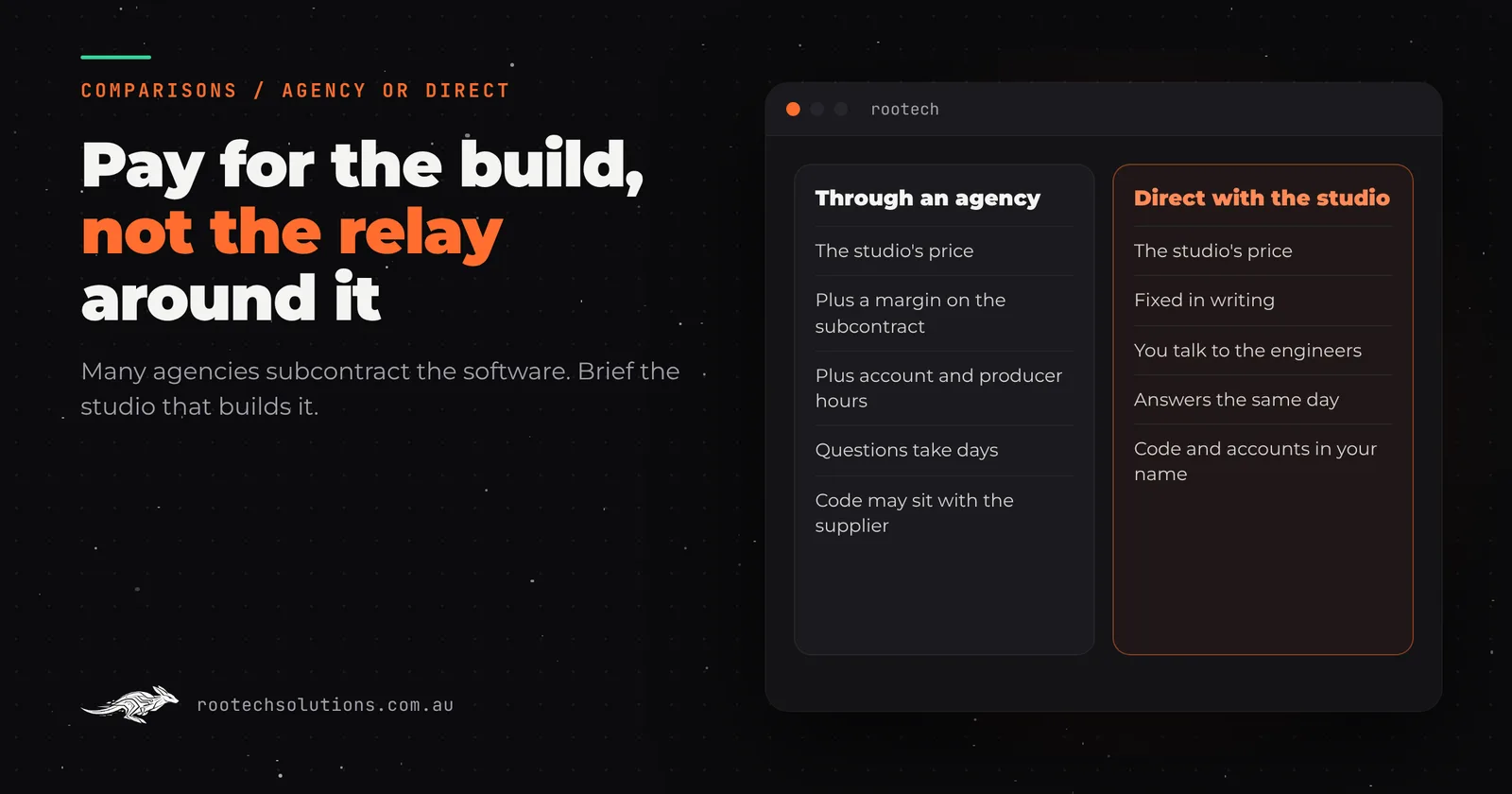
You briefed an agency for an app, a touchscreen or an immersive installation. They were great in the pitch. Then the questions started coming back slowly, every change took a week, and the invoice was bigger than you expected. Here is something agencies rarely put in the pitch deck: on a lot of software and interactive work, the agency is not the one building it. A specialist studio is, and the agency's fee sits on top.
We know because we have been that studio. Several of our installations, apps and VR experiences were delivered through partner studios and agencies, and the same engineers now work directly with brands, exhibitors and businesses across Australia.
Short answer: When an agency does not build the software itself, it briefs a specialist studio and adds a margin, plus account management hours, on top of the studio's price. You pay for the relay as well as the build, and every question and change goes through an extra pair of hands. Working directly with the software studio removes that layer: a lower price, faster answers, and code you own outright. An agency still earns its fee when it is genuinely coordinating many suppliers, or doing creative work you cannot do yourself.
Who actually builds your software when you hire an agency?
Often, not the agency. Many creative, marketing and event agencies do not have their own engineers for touchscreens, AR, VR, computer vision, custom web apps or AI integrations. Building that capability in-house is expensive and the work is irregular, so they subcontract it to a studio that does it every day, sometimes under the agency's name ("white label"), sometimes openly as a partner.
There is nothing wrong with that arrangement in itself. The question is what you are paying for. If the agency's contribution is the brief, a few status emails and a margin on the studio's invoice, you are paying a premium to be one step further from the people building your product.
You can usually find out by asking one question in the pitch: "Who will write the code, and can I talk to them?" If the answer is a name in another company, you are buying a relay.
Where does the agency's cut come from?
From four places, and all four are on your quote. We will not guess another company's percentages; ask your agency to show them.
| What you pay for | Agency with a subcontracted build | Working directly with the studio |
|---|---|---|
| The build itself | The studio's price | The studio's price |
| A margin on the subcontract | Yes, added to the studio's price | None |
| Account management and producer hours | Billed to relay the brief and the feedback | The engineer you talk to is the one building |
| Contingency for supplier risk | Often added, because the agency carries the studio's risk | Fixed price, agreed in writing up front |
| Revision rounds | Each change passes through two companies | One conversation, one change |
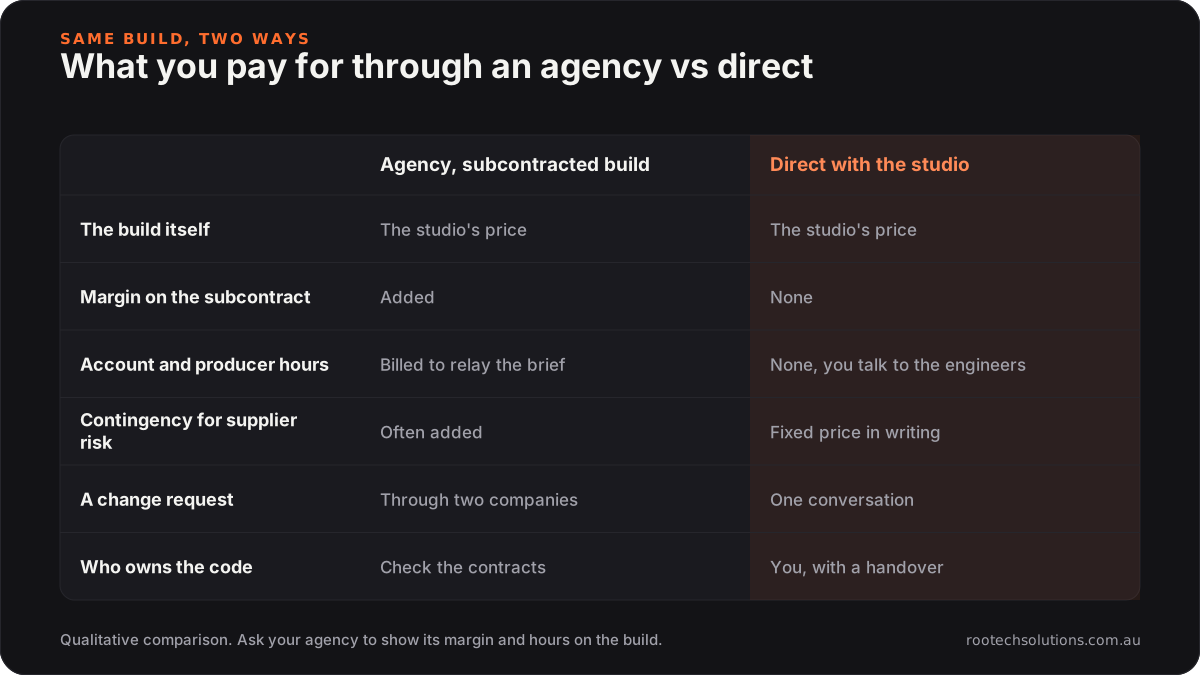
Caption: Same build, same engineers. The difference is the layer in between.
The build line is identical in both columns. Same engineers, same hours, same software. Everything else in the agency column is the cost of the layer.
What else gets lost in the relay?
Money is the visible cost. The less visible ones are often bigger:
- Detail. Your product manager explains how the product works to an account manager, who writes it in a brief, which a producer passes to the studio. Each handoff drops something. The studio builds what the brief says, not what you meant.
- Time. A question from the engineer goes to the agency, then to you, then back. A one-line answer takes days. Multiply that by every question in a project.
- Changes cost twice. A change request is scoped by the agency, quoted by the studio, marked up by the agency, and approved by you. Small fixes become small projects.
- Ownership. The code may sit in the studio's accounts under an agreement with the agency, not with you. When the agency relationship ends, getting your own software out can be harder than it should be. Check the contract for who owns the code and the accounts before you sign.
- Support after launch. When something breaks on day two of a show, you call the agency, who calls the studio. By the time anyone touches the code, the day is half gone.
Why is working directly cheaper for everyone involved?
Because the savings are not only the margin. Removing the relay helps every party in the project:
- You pay the build price without a margin or relay hours on top, get answers the same day, and own the code, the accounts and the data.
- The engineers hear the brief from the person who knows the product, ask questions directly, and spend their hours building instead of rewriting work that got lost in translation. Fewer misunderstandings mean fewer revision rounds, which is how a fixed price stays fixed.
- Your visitors, customers or staff get software built around how they actually use it, because the people building it can talk to the people who know them.
- Your agency, if you keep one, can spend its time on what it does best: campaigns, creative, media, event logistics, rather than relaying technical questions it cannot answer.
The interactive touchscreens for less post goes further into why a small team of engineers, using AI on the repetitive parts of a build, can quote less than a layered model.
When is an agency worth paying for?
Sometimes the layer is the job. An agency earns its fee when:
- It is coordinating many suppliers at once. A full exhibition stand with a builder, AV hire, print, staffing, catering and software is a real project management job, and paying one party to own all of it can be worth it.
- You need creative strategy, not just software. Brand positioning, a campaign idea, copywriting and art direction are skills of their own. If the software is one small part of a bigger creative campaign, the agency may be the right lead.
- You have no time to manage anything. If nobody on your side can spend an hour a week on reviews, someone has to, and that someone costs money.
- The agency builds in-house. If the people in the pitch are the people writing the code, you are already working direct. Ask.
If none of those apply, and the software is the main thing you are buying, go to the studio.
How do you work directly with a software studio?
Split the brief. Keep your agency (or your own team) for creative, media and logistics, and brief the software directly. A good studio will take your brand guidelines and existing assets and build to them. Before you sign, ask:
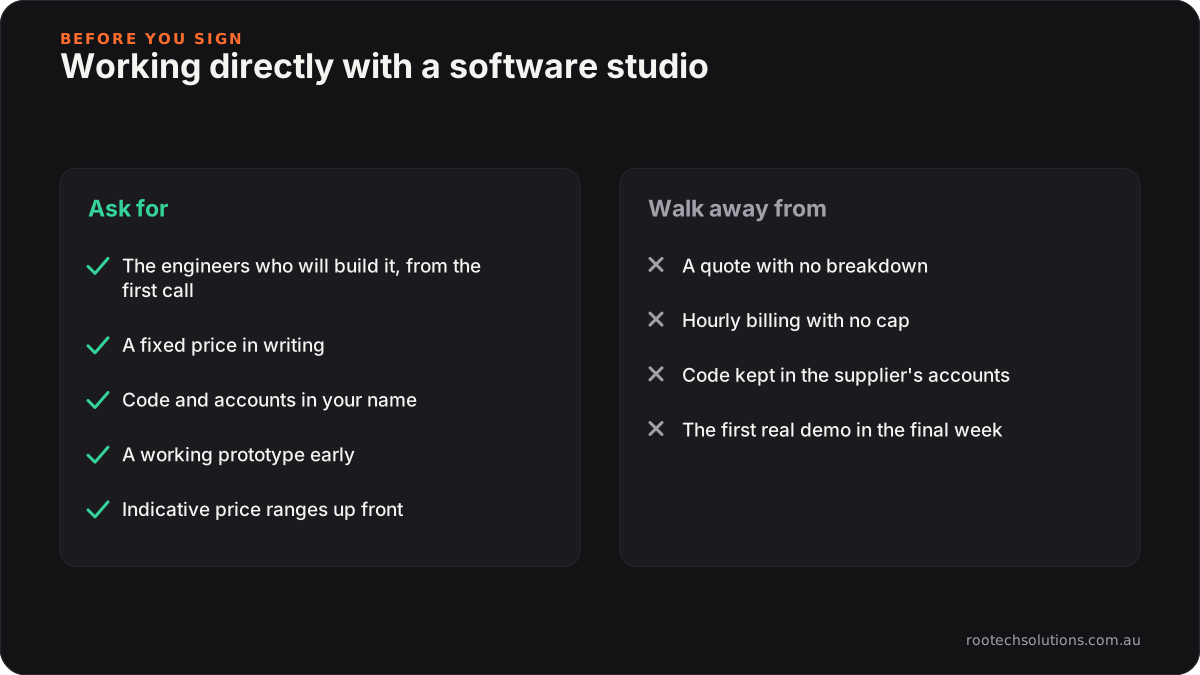
Caption: Five things to ask for, four to walk away from.
- Can I talk to the engineers who will build it? From the first call, not after the contract.
- Is the price fixed, in writing? And what happens if the scope grows.
- Who owns the code and the accounts? It should be you, with a handover of code, documentation and credentials at launch.
- When do I see something working? A prototype on the real hardware or a live URL early, not a deck.
- What do similar builds cost? A studio confident in its pricing will tell you ranges up front.
What does working directly with Rootech look like?
You talk to the engineers who build your software, from the first call to launch. Every project is fixed price, agreed in writing before we start, and most builds ship in two to four weeks; bigger builds get a fixed timeline up front. You own the code, and the accounts it runs on stay in your name. Bug fixes on anything we built are included after launch, and ongoing support is optional, month to month.
We publish our ranges for interactive work, so you can compare any quote, ours or an agency's, before you sign. A templated touchscreen app is typically $5,000 to $15,000, a bespoke 3D product touchscreen $25,000 to $60,000 and a computer vision or motion game $30,000 to $80,000, software only, excluding GST. See what a trade show touchscreen costs for the full list.
Our work includes a trade show touchscreen for CoolIT Systems, a computer vision installation for Nutrien, the Creatures of Australia immersive exhibition, and AI tools such as the Logic Building Co takeoff estimator. Several of these were delivered with or through partner studios; now you can brief the same engineers yourself. We are based in Melbourne and work Australia-wide, remotely by default. If you are planning an installation, start with our guides to immersive installations in Australia and touchscreen installations that generate leads.
Already have software an agency built and want to take it in-house or move it to a new team? Our software maintenance service takes over code another developer or agency built.
Frequently asked questions
Do agencies subcontract software development?
Many do, particularly for specialist work such as touchscreens, AR, VR, computer vision, custom apps and AI integrations. Ask the agency who will write the code and whether you can talk to them. If it is another company, the agency is subcontracting.
Is it cheaper to hire a software developer directly instead of an agency?
Usually, when the software is the main thing you are buying. Working directly removes the agency's margin on the subcontract, the account management hours spent relaying the brief, and the extra revision rounds that come from handoffs. The build itself costs the same.
Can I keep my agency and still brief the software directly?
Yes. Split the brief: the agency handles creative, media and event logistics, and you brief the software studio directly with the agency's brand guidelines and assets. Both teams then work on what they do best.
Who owns the code if an agency subcontracts the build?
It depends on the contracts between you, the agency and the studio, so check before you sign. With Rootech, you own the code and the accounts it runs on stay in your name, with a full handover at launch.
Does Rootech work with agencies?
Yes. Several of our projects were delivered with or through partner studios. We also work directly with brands, exhibitors and businesses, and we are happy to work alongside your agency on a split brief.
Brief the engineers directly
Tell us what you want built and what an agency has quoted, if you have one. Start a project and we will come back with a fixed price, a timeline and the names of the people who will build it.