Immersive Installations in Australia: A Buyer's Guide
What an immersive installation is, where it works in Australia, what it costs and how to brief one. Projection, motion, AR and VR, built at a fixed price.
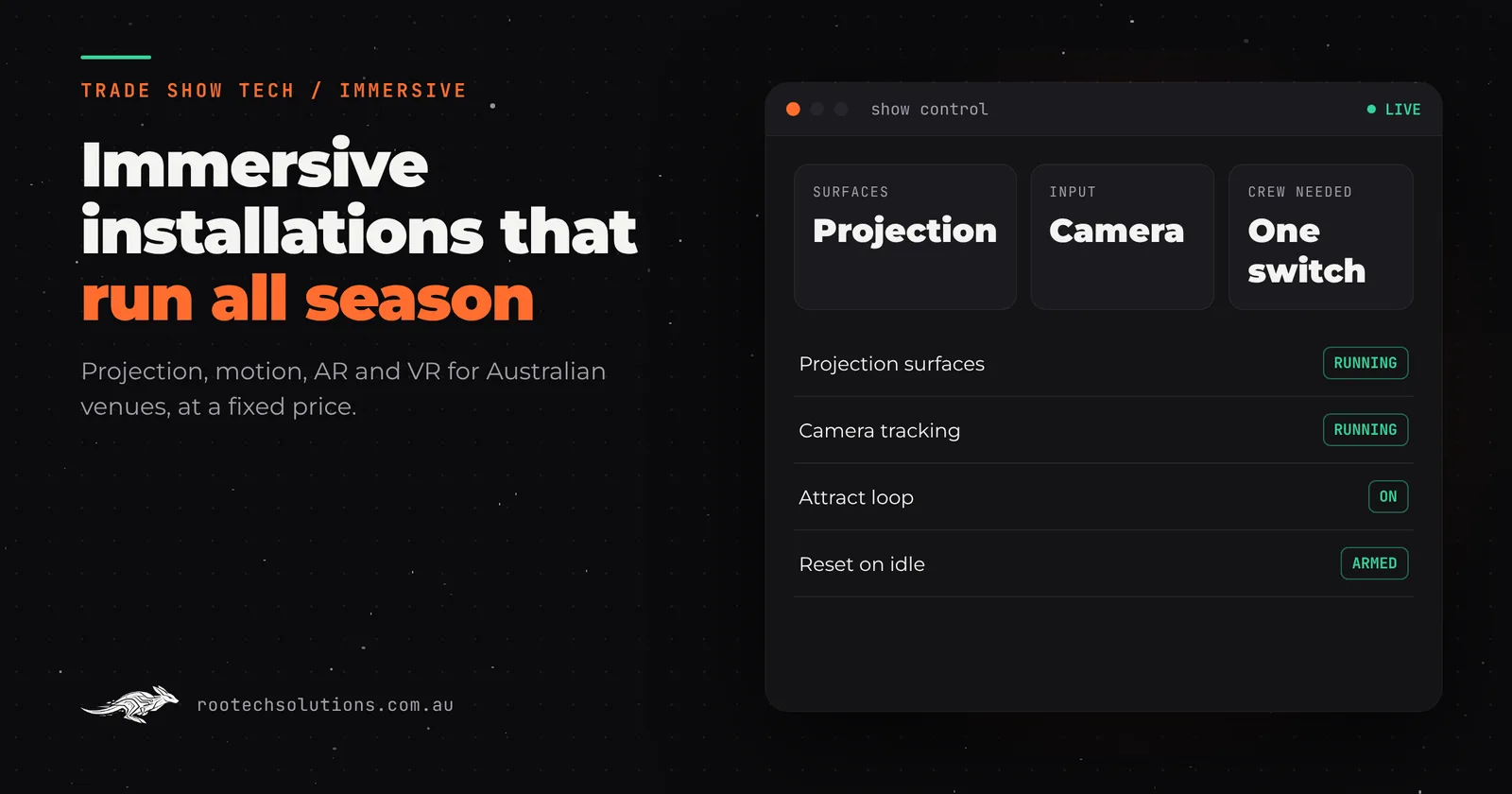
You have a space and an audience: a museum gallery, a shopping centre atrium, an expo stand, a display suite, a visitor centre. You want people to stop, step in and remember it. "Immersive installation" is the phrase on the brief, and it can mean anything from one big screen that reacts to a wave to a pavilion of projection that runs every day for a season.
Short answer: An immersive installation is software that surrounds or responds to the visitor: projection rooms, walls and floors that react to movement, computer vision games, AR and VR. In Australia they work best in museums and exhibitions, shopping centres, expo stands, display suites and visitor centres. Rootech builds them at a fixed price; a computer vision or motion game is typically $30,000 to $80,000, software only, excluding GST, and larger multi-room work gets a fixed quote after discovery.
What counts as an immersive installation?
Anything where the visitor is inside the experience or is the controller, not a viewer of a screen. In practice that covers six kinds of build, and most real installations combine two or three.
| Type | What the visitor does | Rootech work that shows it |
|---|---|---|
| Projection room or exhibition | Walks through large-scale projected environments that respond to them | Creatures of Australia |
| Computer vision or motion game | Moves their body; a camera turns it into play | Nutrients 4 Revolution |
| Interactive character or mirror | Waves, poses and takes a photo with something on screen | Sammy the Snowman |
| Augmented reality | Sees a product or process layered over the real world | Shell Deep Water, Bayer AR Activation |
| Location-based VR | Walks freely through a shared virtual world with a group | The Little Prince: Call to Adventure |
| Large touchscreen with 3D | Opens up a product, building or system with their fingers | CoolIT Systems, Minto Apartments |
The common thread is that the software has to run in a real room, unattended, for real crowds. That is a different job from a website or a video, and it is where most of the engineering goes.
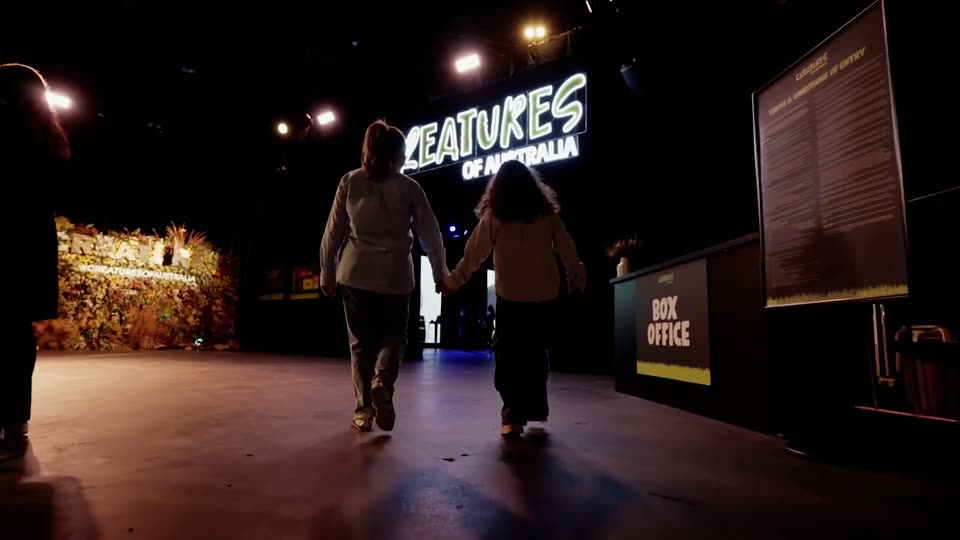
Caption: Creatures of Australia, built with Zebrar for AGB Creative: projection and interactive environments across a whole pavilion.
Where do immersive installations work in Australia?
Anywhere people arrive with a few minutes and a reason to be curious. These are the settings we see briefs from most often:
- Museums, galleries and touring exhibitions. The installation is the exhibit. Creatures of Australia opened at the Fever Pavilion in Sydney Olympic Park in partnership with the Australian Museum, with an interactive layer that runs across the whole pavilion on a full-time schedule, and is being prepared for an international tour.
- Shopping centres and retail. Seasonal activations that families stop for. Sammy the Snowman put a life-size animated snowman on screen with shoppers in a Calgary mall from open to close for a whole holiday season. The same approach suits an Australian centre's school holidays or Christmas program.
- Expo and trade show stands. A motion game or AR demo draws a crowd at the Melbourne Convention and Exhibition Centre, ICC Sydney, the Brisbane Convention and Exhibition Centre or the Perth Convention and Exhibition Centre, then hands the visitor to the team. We cover the stand version in motion games for Sydney caravan and camping shows and VR site tours at Melbourne energy expos.
- Display suites and sales offices. Buyers explore a building that does not exist yet, unit by unit, as they do on the Minto sales office touchscreen.
- Visitor centres, tourism and education. A place, a process or a story told at room scale. Our VR work for PetroLMI, Experience the Energy, takes people onto energy sites they would otherwise never see.
- Brand activations and events. A one-off experience that travels: AR on a phone, a VR headset at a booth, a projection piece at a launch.
What makes an immersive installation actually work?
Reliability first, spectacle second. A beautiful piece that crashes on day three, or that only one person can use while a queue builds, costs you more goodwill than a plain screen. The checks we design for from the first week:
- It runs unattended. Starts itself when the power comes on, recovers from a crash without anyone touching it, and resets when a visitor walks away.
- It handles the crowd. Throughput is designed, not hoped for. How many people at once, how long each one stays, what the people waiting see.
- It reads instantly. A visitor should understand what to do within seconds, without instructions. If it needs a staff member to explain it, it is not finished.
- It is tested in the real conditions. The real projector, the real camera, the real lighting. Venue lighting and reflective floors change how computer vision behaves, so we test early and on site where we can.
- It can be updated. Content, languages and branding change between seasons and shows without a rebuild.
- It is accessible. Something for visitors who cannot or would rather not move, and content that does not rely on sound alone.
- Show control is simple. The crew who opens the venue each morning needs one switch, not a laptop and a phone number.
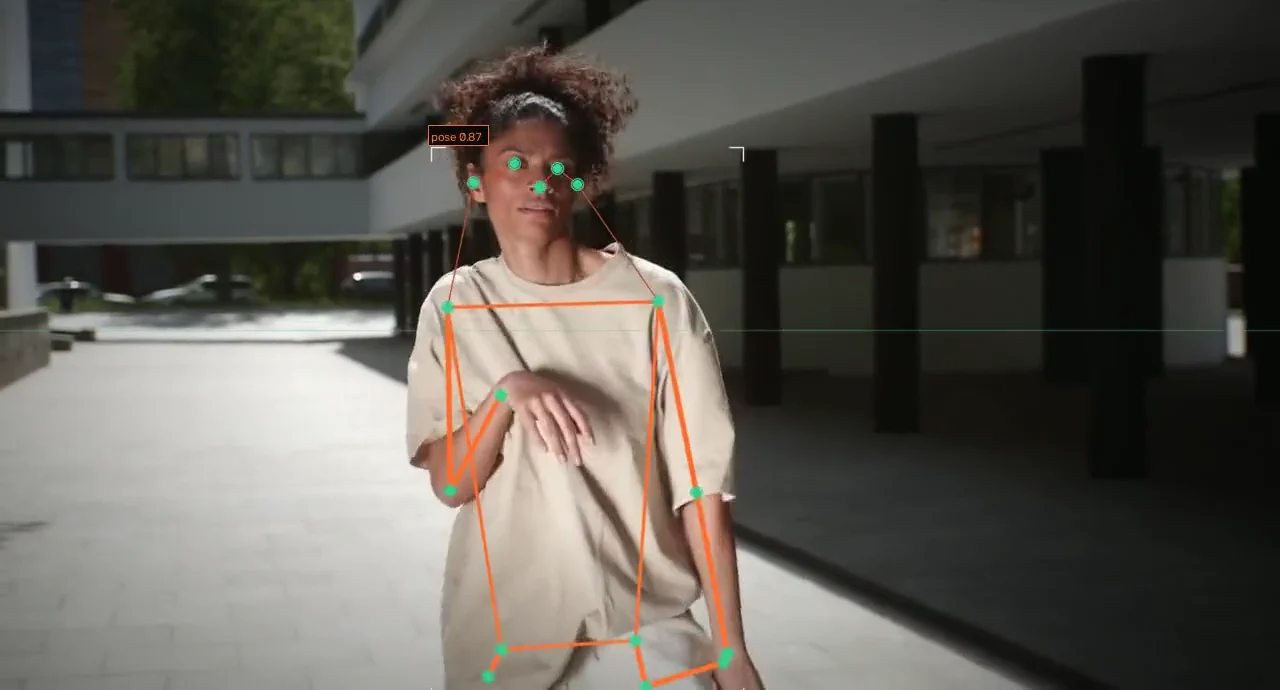
Caption: Under a motion game: a camera tracking the body, so the visitor needs no controller.
What does an immersive installation cost in Australia?
It depends mostly on scale and how much has to be custom-made, so we publish ranges where the build is repeatable and quote the rest after discovery. These are indicative, in AUD, software only, excluding GST:
| Build | Indicative range |
|---|---|
| Custom touchscreen with video and animation | $15,000 to $30,000 |
| Bespoke 3D product touchscreen | $25,000 to $60,000 |
| Computer vision or motion game | $30,000 to $80,000 |
| Lead capture with CRM integration (add-on) | $4,000 to $12,000 |
| Multi-room projection, location-based VR, touring exhibitions | Fixed quote after discovery |
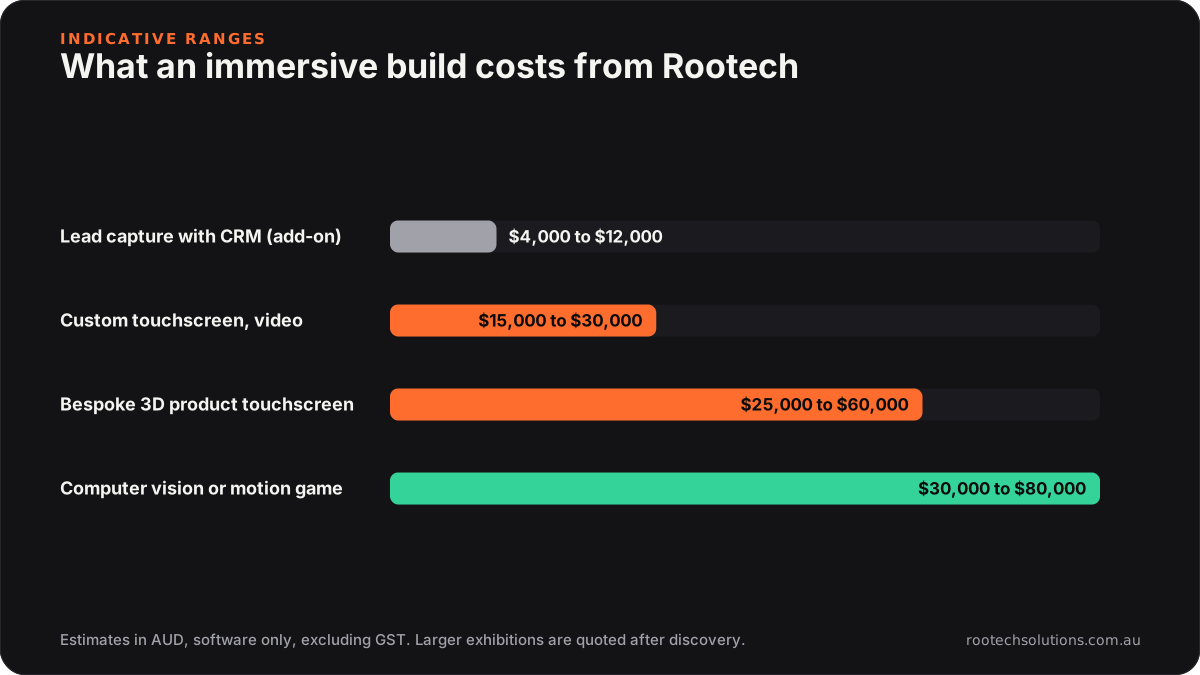
Caption: Published ranges, so you can test any quote against them. Larger exhibitions are quoted after discovery.
Hardware (projectors, screens, cameras, headsets, computers) is usually hired or bought separately, and we build for whatever you choose or help you spec it. Running costs are small: hosting, where an installation needs any, is usually under $50 a month. Every project is fixed price, agreed in writing before we start. For a breakdown of what moves the number on stand builds, see what a trade show touchscreen costs.
How long does an immersive installation take?
Most builds ship in two to four weeks. A multi-screen or multi-room installation gets a fixed timeline up front, agreed with the price. The schedule is usually set by the opening date, so the order matters: a working prototype on the real hardware early, content and polish after, and time on site (or on a call with the venue crew) before the doors open.
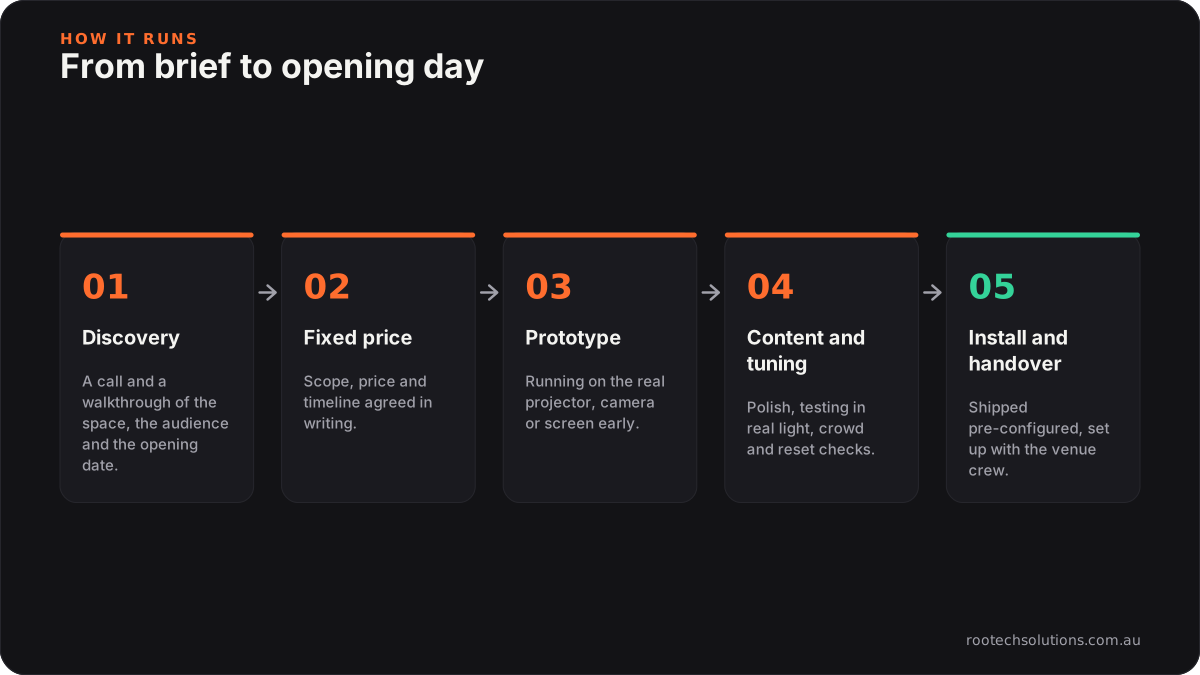
Caption: The prototype runs on the real hardware early, so feedback is on the thing itself, not a slide.
Can a Melbourne studio deliver an installation in Sydney, Brisbane or Perth?
Yes. Rootech is based in Melbourne and works Australia-wide. Outside Melbourne, delivery is remote by default: discovery and reviews over video, builds in the cloud, and the installation shipped pre-configured and set up with your team or the venue's AV crew over a call. We travel only for the rare install that cannot be done any other way, and we say so in the quote. That keeps flights and hotel nights off your budget.
How should you brief an immersive installation?
You do not need a creative deck. You need answers to these, and a call fills the gaps:
- The space. Where it goes, how big, what the light is like, where the power and network are.
- The audience. Who walks past, how long they have, how many arrive at once.
- The one takeaway. What should a visitor know, feel or do after two minutes?
- The run. One weekend, a season, or a tour across venues.
- The hand-off. Does the experience end in a photo, a share, a lead form, or a conversation with your team? If leads matter, read how touchscreen installations generate leads.
- The hardware. What you already own or have hired, or whether you want us to spec it.
You also do not need to go through an agency to brief us. Many of our immersive projects were delivered with or through partner studios such as Braveshell, MammothXR and Zebrar, and the same engineers now work directly with venues, exhibitors and brands. We explain what that saves in why working directly with the software studio is cheaper.
Frequently asked questions
What is an immersive installation?
An immersive installation is software that surrounds the visitor or responds to them, such as a projection room, a wall or floor that reacts to movement, a computer vision game, an AR experience or a location-based VR world. The visitor is inside the experience or is the controller, rather than watching a screen.
How much does an immersive installation cost in Australia?
From Rootech, a computer vision or motion game is typically $30,000 to $80,000 and a bespoke 3D product touchscreen $25,000 to $60,000, software only and excluding GST. Multi-room projection, location-based VR and touring exhibitions get a fixed quote after discovery. Hardware is separate.
How long does it take to build an immersive installation?
Most builds ship in two to four weeks. Multi-screen and multi-room installations get a fixed timeline up front, agreed with the price, and the plan works back from your opening date.
Can you install outside Melbourne?
Yes. Rootech works Australia-wide. Outside Melbourne the installation is shipped pre-configured and set up with your team or the venue's crew over a call, and we travel only for the rare install that cannot be done another way.
Who owns the installation software?
You do. The code and the accounts it runs on are in your name, launch comes with a handover of the code, documentation and credentials, and bug fixes on anything we built are included after launch.
Talk to the engineers who will build it
Tell us the space, the audience and the opening date. Start a project and we will come back with a fixed price and a timeline, or an honest view on whether a simpler build would do the job.